


Automated, but Not Transformed?
What We Learned in Halle About AI, HR and Leadership
Once a year, we at flow make a conscious decision to take some time out for ourselves. No client meetings, no seminars to run – just a few days when we consultants get to be the learners for a change.
This summer, our annual workshop took us to Halle (Saale), a city that has more to offer than you might expect: a rich history, plenty of green spaces and a lively university scene. Just the right place to reflect on the future of work.
At the heart of our discussions was a question that comes up in almost every client project: what is AI changing in HR, and what does it mean for leadership? To explore this, we invited two guests who have been researching and working with these questions for years: Dr Christian Hoßbach and Christopher Müllner, MSc, from the Chair of Human Resource Management and Business Governance at Martin Luther University Halle-Wittenberg and the AI-HR-Lab. Their session was entitled “Automated, but Not Transformed? Three Years of AI in HR Under the Microscope”. It gave us plenty to think about long after the workshop had ended.
The key insight: automation is not transformation
The AI-HR-Lab has been exploring how AI is changing HR since 2018. The session was therefore firmly rooted in practical experience. One finding stood out: many AI tools in HR simply automate existing processes. They digitise the old ways of working without changing how people think. Genuine transformation only happens when organisations look beyond the technology to consider culture and roles as well.
We also worked with specially designed personas and discussed practical examples. One concerned meeting recordings: when employees know that meetings are being recorded, they tend to think more carefully about what they say. At the same time, recordings make it easier to produce meeting minutes. Whether AI tools are accepted and prove effective depends to a large extent on the level of psychological safety within the team.
Technology alone, then, is rarely the deciding factor. This was the point at which we at flow took the discussion a step further.
Our perspective: leadership shapes the connections
In our work with leaders, we use an established framework built around three elements: people, technology and organisation. The MTO approach has its roots in the socio-technical systems research of Emery and Trist and was further developed by Strohm and Ulich at ETH Zurich.
Our perspective is a little different, though. Rather than focusing on the three elements themselves, we pay particular attention to the connections between them. After all, it is where people, technology and organisation meet that determines whether AI works in practice.
The people–technology interface. This is about how people work directly with AI tools. The key is to ensure that theydo not outsource their thinking to AI. Instead, as most of our clients prefer, they should use it as a sparring partner – a way to test ideas, challenge assumptions and explore different perspectives. Otherwise, it is all too easy to end up with results that look convincing but lack substance. This is not an argument against AI, but a case for developing thoughtful, deliberate ways of using it.
The technology–organisation interface. This is where processes, structures and responsibilities come into play. A feeling of being in control is no substitute for proper checks. There is also an important regulatory consideration: as of 2 August 2026, most provisions of the EU AI Act have become applicable, including obligations relating to high-risk AI systems. These can include AI applications used in recruitment and selection.
The organisation–people interface. This is about involvement, culture and trust. The key question is not, “Where can we introduce AI?” but rather, “What role should AI actually play in the way we work together?” Teams that take the time toagree on this are better placed to shape how AI is used – and where it should not be used.
One team, three interfaces: what this looks like in practice
Imagine an eight-person sales support team. This is a fictional example, but one that may sound familiar. Several team members have started using AI on their own initiative to prepare quotations and draft correspondence with customers. The quotations are ready more quickly, but they need more revisions: the wording is polished, yet the content often feels generic.
Looking at the situation through the three interfaces turns a vague sense of unease into something tangible. At the people–technology interface, the team lacks a shared understanding of what the tool is actually good for. At the technology–organisation interface, it is unclear who should check the content before it goes out. And at the organisation–people interface, what is needed is genuine involvement rather than instructions handed down from above.
The result is three small, targeted measures rather than one major programme. We will show you what they are in our webinar.
Leadership shapes the impact
During our summer workshop in Halle, we spent a long time discussing what is genuinely new about leadership in the age of AI. Our answer? Surprisingly little.
Long before the current AI hype, Frankiewicz and Chamorro-Premuzic made the point succinctly in Harvard Business Review: “Digital Transformation Is About Talent, Not Technology.” Or, as we would put it: technology changes the tools. Leadership shapes the impact.
The fundamentals still apply:
- Start with the problem, not the tool.
- Be clear about roles and responsibilities.
- Make sure results are checked consistently and reliably.
- Involve people actively rather than simply keeping them informed.
More than AI: historic foundations, a photo shoot and a meal together
As lively as our discussions about AI agents, HR and psychological safety were, a summer workshop at flow is never just about the professional programme. We believe that good consulting depends on people who stay curious – including about things beyond their own area of expertise.
That is why we made time to visit the Francke Foundations, one of Halle’s most remarkable historic sites. Walking through the old buildings, you get a sense of the education, courage and determination that came together here over the centuries. It was a fitting backdrop for conversations about what learning in organisations can look like today.
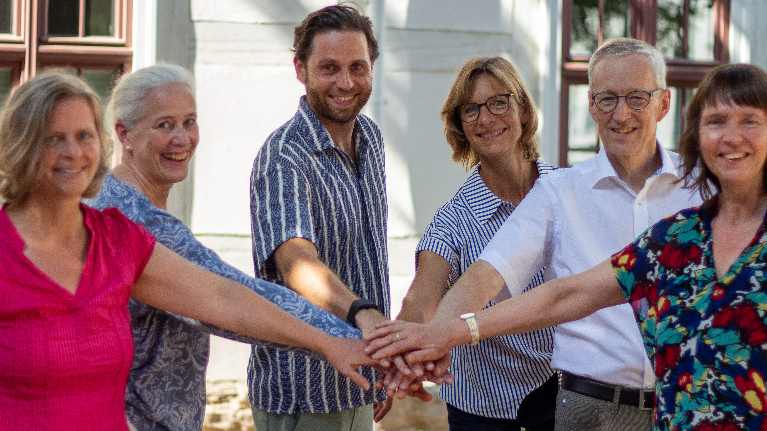
Then came something a little out of the ordinary for us: a photo shoot. Consultants who are usually the ones standing in front of a room suddenly found themselves in front of the camera. There was plenty of laughter, more than a few takes and, in the end, a set of photos we are looking forward to seeing.
And because good ideas need feeding, we sat down to dinner together that evening. The food was delicious, the conversation went on late, and before long we were talking about much more than AI.
Perhaps that is the most valuable lesson from the workshop: what AI cannot replace is precisely what happens on evenings like these.
Keep the conversation going: our free webinar on 4 November 2026
If you are exploring questions around AI, HR and leadership in your own organisation, we would be delighted to continue the conversation with you.
Our free online workshop, “AI Management for Leaders: Understanding, Assessing and Shaping AI”, focuses on precisely the point that stayed with us after Halle: the interplay between technology, organisation and people.
- When: Wednesday, 4 November 2026, 10.30 am–12 noon CET
- Where: Online via Zoom
- Who for: Leaders at all levels, HR professionals and anyone with an interest in the subject
- What we will cover: The three MTO interfaces as a practical framework, recent studies from 2024 to 2026, the fullcase study and our AI Readiness Check – a practical tool to take away and use in your own organisation.
I look forward to seeing you there!

